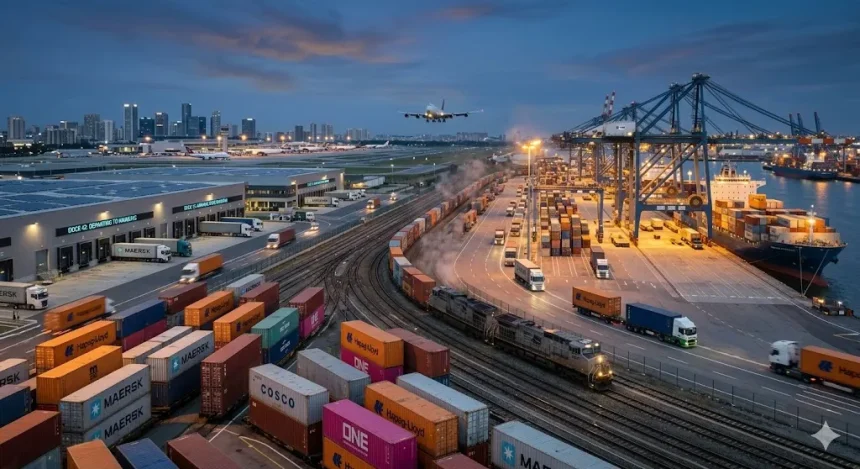
According to a comprehensive analysis by Market Research Future, the global Logistics Market was valued at USD 10,170.0 billion in 2024 and is projected to grow from USD 10,780.2 billion in 2025 to USD 19,305.7 billion by 2035, exhibiting a compound annual growth rate (CAGR) of 6.00% throughout the forecast period. This near-doubling of market value — from just over USD 10 trillion to nearly USD 20 trillion in a single decade — represents the most compelling evidence yet that logistics is not merely a cost of doing business but one of the world’s largest and most dynamic growth industries in its own right.
The Structural Forces Reshaping Global Logistics
The global logistics industry is undergoing the most fundamental transformation in its history, driven by the simultaneous convergence of four structural forces that are reshaping every dimension of how goods move, how supply chains are managed, and what customers expect from the companies that serve them.
The E-commerce Revolution and Its Last-Mile Imperative: The explosive and apparently irreversible shift of consumer purchasing from physical retail to digital platforms has transformed logistics from a business-to-business wholesale distribution function into a consumer-facing service industry where delivery speed, real-time tracking transparency, and seamless returns management are competitive differentiators that directly determine customer loyalty and brand equity. E-commerce has created an entirely new logistics sub-sector — last-mile delivery — that is simultaneously the most expensive, the most complex, and the fastest-growing segment of the entire logistics value chain. The density economics of last-mile delivery in urban environments, where a single delivery vehicle may make dozens of stops within a few city blocks, are radically different from the long-haul freight economics that historically dominated logistics planning, requiring entirely new approaches to route optimization, vehicle fleet management, delivery time window scheduling, and the management of consumer-driven returns flows that can represent 20–30% of e-commerce order volumes. The E-commerce sector stands as the largest end-use segment of the global logistics market — valued at approximately USD 5,000 billion in 2024 with projections toward USD 12,000 billion by 2035 — a trajectory that makes the e-commerce logistics opportunity one of the most significant in the entire industry.
Digital Transformation and the Intelligence Revolution: The logistics industry is experiencing a profound digital transformation that is converting what was historically a labor-intensive, paper-based, relationship-driven industry into a data-intensive, algorithmically optimized, platform-mediated business. Artificial intelligence and machine learning algorithms are now being deployed across every major logistics function: demand forecasting that predicts freight volumes weeks or months in advance; dynamic route optimization that continuously recalculates delivery sequences in response to real-time traffic, weather, and capacity data; predictive maintenance systems that identify potential vehicle or equipment failures before they cause costly breakdowns; automated warehouse management systems that direct robotic picking and sorting operations with precision and throughput impossible to achieve through human labor alone; and freight pricing engines that process hundreds of variables simultaneously to generate real-time spot rates that reflect actual market supply and demand conditions. The Internet of Things — the networked ecosystem of sensors, RFID tags, GPS trackers, temperature monitors, and connected vehicles that provide real-time visibility into the location, condition, and status of shipments anywhere in the global logistics network — has emerged as the largest technology segment in the logistics market, providing the data foundation upon which AI analytics operate. Meanwhile, artificial intelligence is the fastest-growing technology segment, as its capacity to transform raw IoT data into actionable operational intelligence is being recognized and invested in at an accelerating pace across every tier of the logistics industry.
Sustainability as Strategic Imperative: The logistics industry is responsible for approximately 8% of global greenhouse gas emissions, making it a major contributor to climate change and a major target of decarbonization policy across every major market. The transition to sustainable logistics is no longer a voluntary corporate social responsibility initiative but a regulatory necessity in markets including the EU — where the Carbon Border Adjustment Mechanism and mandatory Scope 3 emissions reporting requirements create direct financial exposure for carbon-intensive logistics operations — and an increasingly important commercial differentiator as major shippers embed sustainability requirements into their logistics procurement specifications. FedEx’s announced commitment to transitioning its entire delivery fleet to electric vehicles by 2040, Maersk’s investment in green methanol-powered container ships, and DHL’s GoGreen Plus initiative for carbon-neutral shipping options all reflect the recognition by the world’s leading logistics companies that sustainability is not a cost but a competitive investment that will increasingly determine which logistics providers win long-term contracts from environmentally committed corporate customers.
Get An Exclusive Sample of the Research Report: https://www.marketresearchfuture.com/sample_request/5076
Urbanization and the Complexity of Urban Logistics: As the world’s urban population continues to grow — with approximately 68% of humanity projected to live in cities by 2050 — the logistics challenge of efficiently serving densely populated urban environments is becoming one of the industry’s defining technical and operational problems. Urban logistics must navigate restricted delivery time windows in city centers, low-emission zones that exclude conventional diesel vehicles, limited loading bay infrastructure at retail and residential destinations, congestion that reduces delivery vehicle productivity, and consumer expectations for same-day or even same-hour delivery that require entirely different network architectures from traditional overnight freight services. The proliferation of micro-fulfillment centers — small-format warehousing facilities located close to urban demand concentrations that enable rapid order fulfillment without requiring long-haul trunk routes — is one of the most significant infrastructure investment themes in contemporary logistics, representing a fundamental rethinking of the relationship between warehousing geography and urban delivery economics.
Market Segmentation: A Multi-Dimensional Industry
By Application — Transportation Dominates, Last-Mile Delivery Grows Fastest: Transportation holds the largest application share in the global logistics market, valued at approximately USD 7,190 billion in 2024 and projected to reach approximately USD 15,000 billion by 2035. Transportation’s dominance reflects its foundational role in logistics — without the physical movement of goods by road, rail, air, or sea, no other logistics function can operate. Within transportation, road freight dominates globally due to its unmatched flexibility and door-to-door capability, while air freight is the fastest-growing modal segment, driven by the premium-speed requirements of e-commerce, pharmaceutical, and high-value electronics supply chains willing to pay the higher cost per kilogram that air transport commands. Last-mile delivery, while currently a smaller application segment, is growing at rates that substantially exceed the broader logistics market average, fueled by the structural growth of e-commerce, consumer demand for ever-faster delivery, and the proliferation of delivery orchestration technologies including drones, autonomous delivery robots, and crowdsourced delivery platforms that are beginning to reshape the economics of urban last-mile operations.
By Service Type — 3PL Leads, 4PL Accelerates: Third-Party Logistics (3PL) — where specialized logistics providers manage transportation, warehousing, and distribution functions on behalf of shipper clients — represents the largest service type segment, valued at approximately USD 7,190 billion in 2024 with projections toward USD 15,500 billion by 2035. The 3PL model’s dominance reflects its proven value proposition: by aggregating freight volumes from multiple customers, 3PL providers achieve carrier rate leverage, network density, and operational specialization that individual shippers cannot replicate in-house. Fourth-Party Logistics (4PL) — where a single strategic provider integrates and manages the entire logistics ecosystem on behalf of a client, including the management of multiple 3PL providers, technology systems, and supply chain strategy — is the fastest-growing service type, driven by the increasing complexity of global supply chains that has made comprehensive strategic supply chain management beyond the internal competence of many large corporations. Supply Chain Management services, valued at approximately USD 5,792.5 billion in 2024, are projected to nearly double to USD 13,000 billion by 2035 — one of the largest absolute growth opportunities in the entire logistics market.
By End Use — E-commerce Largest, Healthcare Fastest-Growing: Beyond e-commerce’s market-leading position, the healthcare logistics segment has emerged as the fastest-growing end-use vertical, driven by the pandemic-era recognition of the critical importance of pharmaceutical supply chain resilience, the growth of cold chain logistics requirements for biologic drugs and vaccines, and the regulatory intensification around pharmaceutical distribution that requires specialist capability in temperature monitoring, chain-of-custody documentation, and regulatory compliance that general logistics providers often cannot adequately deliver. The automotive sector — with its just-in-time manufacturing philosophies, complex multi-tier supplier networks spanning multiple continents, and zero-tolerance for delivery failures that halt production lines — remains one of the most demanding and strategically important logistics end-use verticals, increasingly challenged by the transition to electric vehicles that is reshaping automotive supply chain geography as battery supply chains substitute for traditional powertrain component networks.
Buy this Premium Research Report: https://www.marketresearchfuture.com/checkout?currency=one_user-USD&report_id=5076
Regional Market Dynamics
North America holds the world’s largest regional logistics market share, valued at USD 7,190.0 million (billion) in 2024, anchored by the United States’ extraordinary combination of the world’s most developed e-commerce market, the most extensive and technologically sophisticated logistics infrastructure, and the deepest capital markets for logistics investment. FedEx, UPS, and DHL are the dominant competitive forces in the North American landscape, continuously investing in automation, electric vehicle fleets, and AI-driven operational intelligence to maintain their competitive positions against both each other and against the Amazon logistics infrastructure that has emerged as a formidable parallel network. The North American market’s regulatory environment — with the DOT, FMCSA, and FAA providing the framework for freight operations across road, rail, and air modes — creates both compliance complexity and competitive differentiation opportunities for logistics providers with sophisticated regulatory management capabilities.
Europe, valued at USD 4,900.0 million (billion) in 2024, is characterized by the world’s most complex cross-border logistics environment — with 27 EU member states operating under unified trade rules but diverse national regulatory frameworks, infrastructure standards, and consumer expectation profiles — and the most stringent sustainability requirements for logistics operations anywhere in the world. DHL and DB Schenker lead the European competitive landscape, with Kuehne + Nagel providing powerful freight forwarding and contract logistics capabilities across the continent. The EU Green Deal’s implications for logistics — mandatory sustainable aviation fuel blending requirements for air freight, CO₂ standards for heavy trucks, and emissions trading scheme costs for maritime shipping — are reshaping the economics of European logistics in ways that advantage early sustainability investors.
Asia-Pacific, valued at USD 4,500.0 million (billion) in 2024, is the region where the largest absolute expansion in logistics activity will occur over the forecast period, driven by China’s continued dominance as the world’s manufacturing center and largest e-commerce market, India’s rapidly developing logistics infrastructure supported by the National Logistics Policy and PM Gati Shakti initiative, and Southeast Asia’s emergence as an alternative manufacturing and logistics hub. Nippon Express and Kuehne + Nagel are expanding their Asia-Pacific operations to capture growth across the region’s increasingly sophisticated supply chain requirements.
Middle East and Africa, valued at USD 1,444.5 million (billion) in 2024, is positioned as an emerging strategic logistics hub, leveraging the UAE’s geographic location at the crossroads of Asia, Africa, and Europe to develop world-class transshipment, air freight, and free zone logistics infrastructure. The UAE’s Jebel Ali Free Zone and Dubai International Airport — the world’s busiest international cargo hub — position the Middle East as an indispensable node in global logistics networks for the decades ahead.
Competitive Landscape and Key Industry Developments
The global logistics competitive landscape is being reshaped by a wave of consolidation, technological investment, and strategic repositioning that is separating industry leaders from followers at an accelerating pace. In July 2025, Union Pacific announced an USD 85 billion acquisition of Norfolk Southern — a landmark deal that would create the United States’ first coast-to-coast freight railroad, unifying western and eastern U.S. rail networks and creating a single carrier capable of serving every major logistics hub from the Pacific to the Atlantic. Descartes Systems Group’s March 2025 USD 115 million acquisition of 3GTMS strengthened its cloud-based logistics platform for North American transportation management. DSV’s landmark bid for DB Schenker — supported by USD 5.6 billion in development capital from a Blackrock-led investor group — would create one of the world’s largest freight forwarding and contract logistics businesses if completed. EQT’s USD 770.1 million acquisition of Constellation Cold Logistics in October 2024 reflects the premium that private equity places on temperature-controlled logistics infrastructure as pharmaceutical and food cold chain requirements intensify globally. Stonepeak Partners’ USD 3.1 billion acquisition of Air Transport Services Group underscores the attractiveness of air cargo infrastructure as e-commerce volumes sustain elevated air freight demand. These transactions collectively signal that the global logistics industry is entering a period of structural consolidation where scale, technology investment, and network breadth will increasingly determine competitive viability — and where the returns to market leaders will be substantially greater than those available to mid-tier operators lacking the scale to invest in transformative automation and digital capabilities.
For more insights on Market, visit the Market Research Future page and explore detailed market analysis, forecasts, and company strategies.
Food Logistic Market
Food Delivery Logistic Market
Agriculture Logistics Market
Direct to Patient Healthcare Logistics Market
Frozen Food Logistic Market
pharmaceutical logistics market